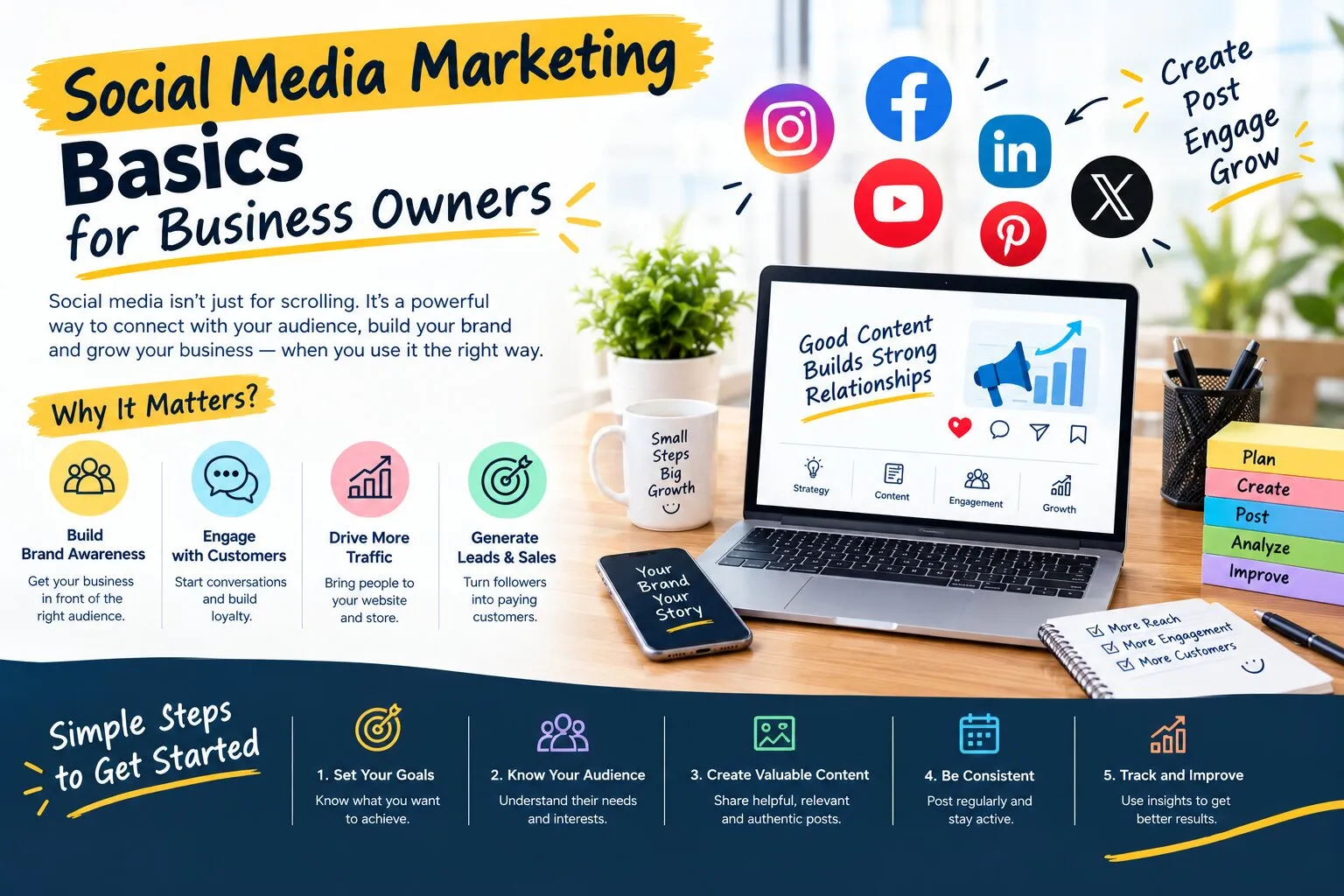
Social media isn't about getting likes or posting daily pictures for the hell of it. It’s just how you stay in front of people, explain your services, build a bit of credibility, and get actual customers closer to pulling out their wallets.
It boils down to pure street math: figure out exactly who has the cash, go stand on the digital platforms where they already spend their time, throw useful value in their face so they stop scrolling, and give them a direct order on what step to take next.
Every single post needs to pull its weight and do real labor for your business. If it isn't driving attention, building leverage, or explicitly pushing people toward a conversion, you're just burning daylight.

What does social media marketing basics actually mean?
"Social media basics" really just means popping up on the few apps your customers actually give a damn about, so you can talk to them like human beings and actually make some sales. That covers everything from quick posts and short clips to teaching people something useful, showing off what you sell, replying to comments, or running paid ads to get in front of fresh eyes.
Setting up your pages properly, keeping your visuals consistent, queuing up posts ahead of time, talking back to people in the comments, and keeping an eye on the numbers so you know if your ads are burning money or actually bringing in sales.
The main thing is that your social media actually ties back to what you do every day. If you run a spot to eat, people just want to see the food, look at the menu, get a feel for the vibe, and figure out where to park.
It all comes down to whatever stops someone from buying. If you sell a service, you have to answer their questions before they'll even email you. If you're selling a physical product, stop talking in circles. Show people how it actually works and why it's worth every single penny you're asking for. Different businesses, exact same rule.
Why should you even care about social media?
Before anyone picks up the phone to hire you, they sneak over to your social pages to see if you're actually legit or just running a front. If they find dead feeds, cringe posts, or zero proof of life, you've killed the sale before you even had a chance to open your mouth.
A messy, inactive profile just makes you look sketchy or out of business. Clean it up, keep it active, and make it stupidly obvious what you offer the second someone clicks on you.
That’s how people operate online. They see a clip, stalk your page, scan your website to check prices or proof, and only then do they drop a message in your inbox.
Social media does not have to produce a sale from one post to be useful.
Sometimes its job is simply to help someone remember your business when they are ready to buy.
Start with the right platform
You do not need to be active on every social media platform.
This is one of the first mistakes business owners make. They make an account on every single app, burn out, and end up abandoning all of them.
Stop overthinking it and just pick the app your actual clients waste time on.
Instagram can make sense for businesses where visuals, products, short videos or behind-the-scenes content matter.
Facebook can still be useful for businesses that depend on local communities, updates, discussions and different types of content.
LinkedIn is particularly relevant for B2B companies, professional services, hiring and business-focused communication.
YouTube can be useful when your business has something that needs explanation, demonstration or longer-form video.
Where you should post entirely comes down to who you’re selling to, what you do, and what you’re trying to get out of it.
What should you post?
This is where many business owners get stuck.
You don't have to shove an ad in people's faces every time you post.
Imagine that you run a website development company. If all you do is yell "buy a website from us" on repeat, people are going to tune you out immediately. Nobody's following an account that just spams "hire us for a website build" every day. Start posting useful shit instead: fix-it tips for broken sites, mobile UX examples, or straight answers to the stuff business owners are constantly searching for online.
If you sell physical stuff, just show the thing in action, answer the basic questions people always ask, and give them tips on how to actually take care of it so it lasts.
For services, just pull back the curtain on how you actually work, clear up the stuff that confuses people, and call out what they need to watch out for before hiring anyone. Put out stuff worth looking at, and people will actually stop scrolling to save it.


A simple content mix works better than constant selling
Your social media content can have different purposes.
Some posts can educate. Some can introduce your products or services. For example, a local service business could have a weekly mix such as:
One useful tip related to the service
One post explaining a common customer question
One product or service-focused post
One short video or demonstration
One customer-focused update or business update
This is only an example. Don't burn yourself out trying to post constantly if you don't have the bandwidth. It's way better to post twice a week with a clear purpose than to spam low-effort crap every single day.
What do you actually want social media to do for your business?
When you actually do social media right, it helps grow your business in a few very real, tangible ways.
It can increase awareness
People cannot consider your business if they do not know it exists.
Regular, useful content can put your business in front of people who may not have searched for it yet.
Most people are just scrolling by. Awareness is usually an earlier step in the buying process.
It can help build trust
Customers often have questions before they buy.
Who are you? What do you offer? Do you understand the problem? What does your product actually do?
Put that stuff out there first, and you answer all their annoying questions before they even hop on a call or walk through your door.
A business that consistently explains its work can be easier for potential customers to understand.
It can bring traffic to your website
A social post can introduce a topic and direct interested people to a relevant page on your website.
Drop a quick post on a common headache your buyers have, and just link them straight to a breakdown on your site where they can read the full fix.
The social post gets attention. The website provides more information.
Tie your content and your website together so they actually help each other out instead of doing their own separate things.
It can generate enquiries
For some businesses, the most useful action is not an immediate online purchase.
It could be a phone call, WhatsApp message, enquiry form, appointment request or direct message.
Make sure it's dead simple for someone to figure out what they're supposed to do next after they read your stuff.
If someone has to search through your profile to find out how to contact you, you are creating unnecessary friction.
It keeps your business in people's minds
People do not always buy the first time they discover a business.
Most people are just window shopping, weighing their choices, or sitting on their hands until the moment is right.
Useful and consistent content gives them a reason to remember your business later.

Do you need paid social media advertising?
Not every business needs to start with paid advertising.
Free content shows you what sticks and what people are actually asking. Paid ads are for when you want to pour gasoline on a specific fire. The main rule? Never run ads if you don't know the exact outcome you're buying.
Before running an ad, decide what action you want people to take. Sending people to a website, getting messages, generating leads and promoting a local offer are different objectives.
A campaign should be judged against its actual goal rather than simply looking at likes.
Followers are not the only thing to measure
A large follower count does not automatically mean a business is getting useful results.
Depending on your goal, you may want to watch metrics such as:
Profile visits
Website clicks
Enquiries
Messages
Video views
Saves and shares
Engagement
Leads generated from campaigns
For example, if your goal is to generate enquiries, a post with fewer likes but several relevant enquiries may be more useful than a post with high engagement and no business response.
Social media performance should be connected to what you are actually trying to achieve.
What should a business owner avoid?
Don't just jump on every trend you see other businesses doing. Something that makes total sense for them might look completely cringe or irrelevant for what you sell.
If Monday is a product post, Tuesday is a random quote and Wednesday is another sales message, the account can start feeling disconnected.
Poorly completed profiles are another missed opportunity. Lock down your handle, email, site link, and a quick pitch on what you actually do, and make sure it looks identical everywhere you show up online. Consistency stops people from getting confused and bouncing.
Also avoid making every post about selling.
People follow you because you're actually giving them something worth looking at. If all you do is pitch them all day long, they’re going to get sick of you real fast.
How much time should social media actually take up?
It really just comes down to whether you're running this whole circus yourself or actually have a team backing you up.
If you're running a small operation, don't kill yourself trying to post every single day. Just pick a stupid-easy plan you can stick to. Give yourself two hours once a week to knock out a bunch of content, set it on autopilot, and only hop back on when someone actually leaves a comment.
Once it gets to be too much, hire someone to take it off your plate. Just don't throw them the keys and run away. You still need to give them the playbook on your business, your voice, and what you actually want out of it.
No one's gonna magically figure out your customers or your business unless you actually sit down and fill them in.


A practical starting plan for business owners
If your business has little or no social media activity, do not try to fix everything in one week.
Start with these steps:
1. Define your goal.
Decide whether you want awareness, enquiries, website visits, sales, community engagement or another clear outcome.
2. Identify your audience.
Think about who actually buys from you. Their location, needs, questions and buying behaviour should influence your content.
3. Select relevant platforms.
Choose the channels where your potential customers are most likely to be active.
4. Improve your profile.
Make it clear what your business does and how someone can contact you.
5. Create a few content categories.
For example, educational posts, product or service information, customer questions, business updates and short videos.
6. Track useful actions.
Look beyond likes. Check whether people are visiting your
